Blog
Behind the Scenes at MCMC: Hospital Nursing
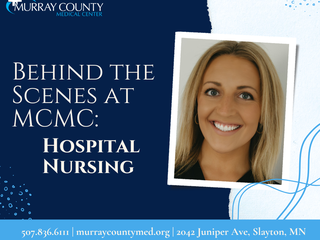
A Better Look into Hospital Nursing Here in SW MN
If you think about careers in healthcare, the odds are you think about nursing.
While everyone knows the job title, not everyone knows the ins and outs of working in nursing. Even less people understand what it looks like from a rural setting.
Courtney Bonnstetter, our Director of Nursing, answered a few questions to help all of us understand what hospital nursing all entails here at Murray County Medical Center.
Hospital Nursing covers many different jobs and roles. Can you explain the different nursing-based jobs in MCMC's hospital and ER settings?
Our hospital nurses wear many hats. As a medical-surgical nurse at MCMC, you're caring for patients of all ages with a wide variety of medical conditions—from pneumonia and heart failure to post-operative patients, swing bed rehabilitation, IV antibiotics, and observation patients.
In addition to caring for hospitalized patients, our nurses also provide emergency care, outpatient services, wound care, and assist with a variety of procedures. Because we're a Critical Access Hospital, our nurses must be adaptable and confident in many different situations. On any given day, a nurse may go from caring for an inpatient recovering from an infection to helping stabilize a trauma patient in the emergency department.
That variety is one of the things that makes nursing at MCMC both exciting and rewarding.
What does scheduling look like in your department?
Our benefited nurses primarily work 12-hour shifts from 7:00 a.m. to 7:00 p.m. or 7:00 p.m. to 7:00 a.m., with every third weekend scheduled.
Our casual nurses are asked to work a minimum of two 12-hour shifts each month—one weekday and one weekend shift—to maintain familiarity with our workflows and patients. We also offer flexibility by allowing nurses to pick up partial shifts anywhere from four to twelve hours when additional coverage is needed.
Holiday coverage is shared among our benefited staff through a rotating schedule, with each nurse typically assigned two holidays each year. Casual staff are asked to work one holiday annually. We strive to build schedules that support both patient care and work-life balance while maintaining adequate staffing around the clock.
What is the best part and most challenging part of being a hospital nurse?
The best part of being a hospital nurse is watching patients improve from the day they are admitted until they are discharged home. It's incredibly rewarding to care for someone during one of the most difficult times in their life and then see them back in the community feeling better. In a rural community, you often continue to see your patients at the grocery store, school events, church, or community activities, which makes those connections even more meaningful.
The most challenging part is that every day is unpredictable. You never know what will come through the emergency room doors or what level of care your hospitalized patients may require. Rural nurses must be prepared to care for everything from critically ill patients and trauma emergencies to pediatrics and elderly patients, often all in the same shift. It requires adaptability, critical thinking, teamwork, and the ability to remain calm under pressure.
What happens before a patient ever sets foot in your area?
Emergency Department
A great deal of preparation happens before a patient even arrives. Our emergency department is always stocked and ready because we never know what will come through our doors. We maintain emergency equipment, medications, and supplies so we can respond quickly to any situation.
If a patient is arriving by ambulance, EMS provides us with a report while they're en route. That allows us to prepare the room, gather the equipment we anticipate needing, notify the emergency provider, and call-in additional staff such as laboratory or radiology personnel if needed after hours.
Many patients also come from our clinic, are referred through a nurse advice line, or call ahead themselves. When patients call before arriving, it gives our team valuable time to prepare and helps us provide efficient care as soon as they walk through the door.
Outpatient
For our outpatient services, preparation often begins well before the patient's appointment. Our pharmacist, Cara Mahon, plays an important role by reviewing medication orders, ensuring medications are available, and coordinating education for the nursing staff when new medications or treatment protocols are introduced.
Our business office works to verify insurance and obtain any necessary authorizations, while nursing prepares supplies, reviews provider orders, and ensures everything is ready so the patient's visit can go as smoothly as possible.
Hospital
Before a patient arrives on our hospital unit, there's a lot of preparation happening behind the scenes. The nurse reviews the patient's diagnosis, provider orders, medications, allergies, and any special care needs. We prepare the room, gather necessary supplies and equipment, and coordinates with departments like pharmacy, lab, radiology, dietary, or therapy services. Once the patient is ready to be transferred, we receive a handoff report so we're ready to provide safe, seamless care from the moment they arrive.
Do you feel there is a difference in nursing at a rural facility like MCMC versus a hospital in a larger city?
Absolutely. Rural nursing is unique because our nurses are true generalists. In many larger hospitals, nurses work within a single specialty, such as ICU, orthopedics, or labor and delivery. At MCMC, our nurses care for patients across many different areas and must be prepared for whatever the day brings.
Another difference is the relationships we build. We're caring for our friends, neighbors, teachers, farmers, coaches, and family members. We know our patients beyond their medical record, and they know us. That creates a level of trust and compassion that's special to rural healthcare.
Our nurses also work closely with one another across departments. Teamwork is essential, and everyone is willing to step in and help wherever needed. Our collaborative environment is one of our greatest strengths.
What's something you'd like for our patients and community to know?
I want our patients and community to know that they are receiving exceptional care close to home. Our nurses are highly skilled professionals who are committed to providing safe, compassionate, evidence-based care every single day.
While we may be a small rural hospital, we provide high-quality care with a personal touch. Our staff genuinely cares about our patients because they're also our neighbors and members of our community. Every decision we make is centered around providing the best possible care while treating each patient with dignity, kindness, and respect.
We are incredibly proud of the work our nursing team does, and we're honored that our community trusts us during some of life's most important moments.
Thank you!
Courtney Bonnstetter - Director of Nursing